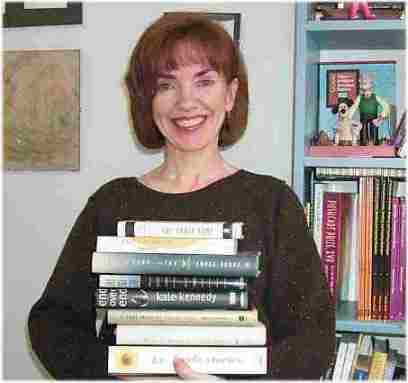
Book Recommendations
Like most writers, I'm a passionate reader. If you're looking for
something to add to your list, check out these recommendations. Most
of my suggestions are books that have not received the attention they
deserve. I know how much I love discovering buried treasures, so I hope
you will, too. When buying books, put your money where your house is:
buy local. Happy reading!
Summer 2007:
Several standouts this summer, books I absolutely adored for varying
reasons.
First, break out the champagne: Anne Fadiman has a new
book of essays, At Large and at Small. She revives the art
of the "familiar essay," and expounds in her amusing,
enlightening, and erudite way on topics as varied as ice cream, night
owls, the essayist Charles Lamb, and moving, among many others. What
marvelous company. I had to look up an average of one word per page,
given her fondness for arcane words and Britishisms. She makes me feel
smarter for having read her. Her previous book of essays on bibliophilia,
Ex Libris, is a perennial favorite of mine.
I also loved a debut collection of linked stories by Waterville,
Maine, writer Ron Currie, Jr. God Is Dead is a
bracing read, utterly fresh and original. Like nothing I've read since
early Vonnegut. After God literally dies in the first story, the others
take place in the outrageous yet
utterly familiar aftermath. Currie laces his stories with both
unbearable sorrow and acid humor, and every character--from God to
hapless functionaries to talking dogs--feels so plainly human. Each story
can stand alone, but they gather immense power in ensemble. I plan to
read the book again, with a fuller appreciation of the stories'
interconnection and long, intelligent arc.
The shining star of my summer reading, though, is Five Skies
by Ron Carlson, one of my favorite short-story writers. This time
out he brings us a novel, a sweeping, intelligent, poignant, emotional
tale of three misfit men who, during the course of a goofball building
project in the wilds of Utah (or possibly Wyoming, I forget), become a
convincing family constellation that I will never forget. The writing is
so beautiful I wanted to eat it.
April 2007:
Memoir is not my usual recommendation--I find the genre suspicious
and often lugubrious--but I read a real corker this month: Girls
of Tender Age by Mary-Ann Tirone Smith. It's a twined
story, threading the tale of the author's upbringing in a Hartford
housing project in the fifties with the gruesome cross-country odyssey
of a child murderer making his way east. Despite the grim (but
never gratuitous) detail, the author manages to spin a tale of loss and
redemption that is moving, witty, insightful, and unforgettable.
Another one--I'm about three-quarters of the way through--I am loving
is Birds in Fall by Brad Kessler. It's the story of
an innkeeper on an island off Nova Scotia who hosts grieving family
members who wish to visit the closest spot to a plane crash that took
their loved ones. Sorrowful and gorgeous, it's the kind of book
that makes you feel fully human and less alone. It's a wow.
And if you're one of the five or six American who haven't read it
yet, 1776 by David McCullough will not let you down.
It read like a thriller, and got me so interested in the humanity of our
founding fathers that I'm also reading biographies of Franklin and
Washington.
Winter 2007:
Winter is a great time for
the classics, especially if you live in northern climes. So fire
up the woodstove and heave in. I'm currently reading Bleak
House by Charles Dickens, and after that I'll either get to some
of his other stuff or switch gears a bit and return to George Eliot and Felix
Holt, her third-to-last novel. Over Christmas I read two
corkers: The Uses of Enchantment by Heidi Julavits was thoroughly
engrossing, about a teenager who either was or wasn't abducted, and the
ever-evolving chain of events that result. Sentence to sentence,
it's marvelously written, with much fascinating wordplay between the
teenager and her therapists as they all try to fulfill their cross
purposes. I was really impressed with this one. And,
building on my newfound knowledge of the neo-Holmes genre, I
enthusiastically recommend The Beekeeper's Apprentice by
Laurie R. King. It imagines Holmes in 1915 taking on a
brilliant young girl as a protegee. Beautifully written and deeply
imagined -- escape reading of the finest kind. I just loved it,
and there are several more books in the series.
Fall 2006:
I've been on a Sherlock Holmes jag, enjoying those marvelous tales
all over again. So clever and devious! Then I discovered (I
don't know how I missed this) an entire industry of neo-Sherlock
literature, in which contemporary writers revisit the great detective
and give him additional cases. The most moving and literary of the
bunch is A Slight Trick of the Mind by Mitch Cullin.
I loved this beautiful novel, which imagines Sherlock
Holmes as a 93-year-old in retirement. It's a gorgeous meditation
on old age, among its other virtues.
Speaking of old age, one of the best novels I've read in ten years is
now out in paperback. It's called Rules for Old Men Waiting
by Peter Pouncey. This is his first novel, and he's in his
late sixties. The prose is so gorgeous and seductive, and though
the story is slow and deliberate (like the narrator), it is thoroughly
absorbing. It's the story of an old man, recently widowed and
dying himself, who aims to write a "story" before he
dies. Give this one a chance--you won't be sorry.
Another book that crossed my path this summer now holds a permanent
place on the bedside table -- The Literary Companion, an
eccentric and entertaining compendium of literary miscellany. Did
you know that Lewis Carroll invented the modern dust jacket? That
Charles Dickens favored David Copperfield over the rest of his
books? The book also contains quotes, literary puzzlers, and tons
of amusing and useless information.
August 2006:
The Unfinished Novel and Other Stories by Valerie Martin
has enchanted me for a couple of nights now. The stories
are strange and sad, with unhappy artists (painters, writers, actors) as
the main characters. Her prose unrolls so effortlessly, and I feel
as if I'm learning something about people I'd have no other way of
knowing.
I also just finished an interesting memoir by Dan Koeppel
called To See Every Bird on Earth. It's the story of the
author's father, Richard, one of the few beings on earth to have seen
more than 7000 bird species. I especially liked the forgiving and
inquiring tone, from a son who grew up with a man with an unquenchable
obsession. This could have been a mean-spirited diatribe, and yet it's a
gentle attempt to understand an outsized passion.
June 2006:
Because I'm on a book tour, I'm getting lots of great recommendations
from booksellers. Many thanks to Lola at Books Etc. in Falmouth,
Maine, for making me read My Year of Meats by Ruth Ozeki.
This utterly original novel is almost impossible to describe, but I
found it both touching and entertaining. Jane Takagi Little, an
American documentary filmmaker with a Japanese mother and Minnesota
botanist father, takes on a job producing a Japanese TV show sponsored
by the beef industry. She has to find "typical American
wives" to profile for a weekly show, each of which ends with the
theatrical cooking of a beef recipe. The wives are hilarious
and/or heartbreaking, but when Jane begins to investigate the beef
industry on the side, the plot thickens. It's one of the most
enjoyable novels I've read in a long time. Take note: you'll never
eat beef again.
April 2006:
I've just discovered the sublime Kate Chopin, whose scandalous little
novella The Awakening ended her career after it was published in
1899. It's about a woman who turns her back on her family for
reasons that may or may not convince you, but the prose is so very
enchanting, and the story takes place in New Orleans at the turn of the
century. The edition I have includes a smart intro by Marilynne
Robinson (author of Gilead and Housekeeping), plus several
other Chopin short stories, including the much-anthologized
"Desiree's Baby." Her insight in to Creole
culture--Chopin married an upper-crust Creole, from whom she was widowed
at 32 with six kids--is also a pleasure.
January 2006:
I have begun the year on a George Eliot jag, beginning with Middlemarch,
my favorite novel of all time. This time through I was enthralled
anew by her wit, her penetrating observations about human nature, her
delicious plotting, her electrically modern thinking, her dizzying,
syntactically precise sentences, her sly, caustic wit. I'm now in
the middle of Daniel Deronda, her final novel, written in the
late 1870s, and I'm just as in love as can be with this marvelous woman.
Instead of making me feel like throwing all my own books into the Sea of
Despair, her sympathy and genius lead me in quite a different
direction. She will inspire any writer who strives to one day
create something called art. And winter is the perfect time to
read her--those long, dark evenings so conducive to settling down with a
long, good book. Why, oh why did she die at age 60? Surely
she had another four or five novels in her!
For Christmas/Hannukah 2005:
Have I got a deal for
you. My friend Bill Curtsinger has a book out that will
knock you flat. It's called Extreme Nature, a
compilation, with commentary, of many dozens of the most soul-filling,
awe-inspiring color photographs I've ever seen. Bill was the first
photographer to photograph harp seals underwater, and that's just the
beginning. He has been to the ends of the earth and back to photograph
creatures that are seldom seen by man. This is a celebration of
his life's work (many of these photographs were taken for National
Geographic), and some have already become so iconic you'll recognize
them instantly. The accompanying prose is what really makes this
book a poignant and thrilling package. It looks like a 200-dollar
coffee-table book, but it's a mere forty bucks at a bookstore near
you. What a steal!
For Fall 2005:
The best novel I've read
recently is so painful that I hesitate a bit in recommending it. We
Need to Talk About Kevin by Lionel Shriver is narrated by
the mother of a boy who perpetrated a school shooting. There are so many
layers to this searing, breathtaking novel that it keeps overwhelming
you anew, days after you've finished the last page. Of the author's
many, many strokes of genius, the most moving for me is her narrator's
artful, formal, and vaguely false use of language--the only thing she
has left to shield herself from the raw pain of her tragedy.
Unforgettable.
Another marvelous novel is Intuition
by Allegra Goodman, a darkly comic and often moving account of a
medical-research lab in Cambridge, Massachusetts, whose discovery of a
virus that cures cancer unleashes a premature blitz of publicity,
shining unwanted light on a great cast of players. The characters
are well drawn and the prose is snappy, smart, and full of heart and,
well, intuition. This will be out soon in hardcover.
Also, two story collections
that I discovered belatedly, and happily: First, Reasons for
Leaving by John Manderino, a light (but not lightweight),
good-hearted coming-of-age story told through a unique structure of
employment mishaps (from delivery boy, age 12, to writer, age 30) is a
constant pleasure, and contains the funniest, sharpest dialogue I've
read in years. It's not a novel, however, despite what the cover says;
it's a series of linked vignettes, and every single one of them
sparkles. I LOVE this guy's prose--clean, clean, clean, with a musical
flow: not a single thud in the entire book. The other is Slow
Monkeys by Jim Nichols, another new voice I just loved.
This guy's beautifully crafted characters, most of them hapless
ne'er-do-wells trying too hard, are rendered with lots of heart and an
authentically dry, wry Maine humor. What a shame that gems like
these (small press, probably a short print run, no publicity) don't get
to shine in a marketplace fogged over with subpar bestsellers.
For May 2005:
Anybody with a backyard--even
a teeny one--will adore Suburban Safari: A Year on the Lawn by
Hannah Holmes. She's been called a "goofball Rachel
Carson for the 21st century," and I can't imagine a more apt
description. Thoroughly researched yet shamelessly unobjective,
this book reveals as much of its witty, loveable author as it does about
the natural world of weeds, bugs, crows, squirrels, and other
critters. Get to know Hannah Holmes and her teeming
backyard. Your own yard will never look the same.
For February 2005:
I've recently come across two
books that enthralled me for entirely different reasons. The first is Warp
& Weft by Edward J. Delaney, a quiet, deeply moving story of
four guys working at a Massachusetts textile mill during the summer of
1978. Delaney captures this milieu with heart-crushing accuracy in a way
that makes you forget you're reading. The other is The Siege of
Salt Cove by Anthony Weller, a touching and hilarious tall tale of a
small coastal community that takes up arms against the Massachusetts
Department of Public Works. Weller employs about 20 different
narrators, each unique and engaging, in this fetching parable of Us
versus Them.
For September 2004:
Ann Hood is such a
graceful writer, and her new book, a collection of stories called An
Ornithologist's Guide to Life, showcases her gifts especially
well. Each story is a gem of economy and style, with interesting
characters making unusual choices.
For June 2004:
Allow me to recommend a book
by Thomas Urquhart, not because he is my friend but because his
book seizes the moribund genre of nature writing and infuses it with
life and wit and a crackling intelligence. (If you don't believe
me, read the rave from the LA Times.) Its first pleasure is the
title: For the Beauty of the Earth: Birding, Opera, and Other
Journeys. A memoir of sorts, this unique book follows the
elliptical, witty, and often moving observations of a man whose eclectic
life and many passions lead, one way or another, back to Mother
Nature. The author is a well-traveled, ferociously observant
raconteur who will capture your attention, your conscience, and your
heart.
For May 2004:
For relief from the blizzard
of books on "closure," I recommend the searing, angry, and
gorgeous One Day My Sister Disappeared, by Christine Orban, whose
beloved sister died at age 37. It's almost unbearably raw, but the
prose, in translation from French, is hauntingly staccato and
poetic. Fascinating.
For anyone interested in
competition, obsession, birds, or all three, The Big Year by
Mark Obmascik is a can't-miss. A Denver post
reporter and marvelous prose stylist, Obmascik treats the reader to an
account of three competitive birders (yes, there is such a thing) who
try to rack up the highest number of bird species ever seen in North
America in a single year. It's hilarious and engaging, full of
human foolishness and human spirit.
For February 2004:
I'm a sports fan, with the
female sports fan's usual caveat: anything but boxing.
Nevertheless, I came across a book on boxing that I couldn't put
down. Cut Time, by Carlo Rotella, is a collection of
connected essays ranging far beyond the usual cliche of boxing as a
metaphor for life. Rotella himself is not a boxer; he's an English
professor and sometime sports reporter. Boxing is his obsession,
and human nature is his business. In his marvelous book you'll
meet characters in all their tough and tender humanity: heavyweight
champ Larry Holmes; Rotella's stiff-jawed grandma; a trio of college
bullies who pick the wrong fight in a bar; an accident victim who
carries a pre-surgery photo of his mangled leg to keep himself in a
perpetual state of awe. Rotella's writing, like his subject, is
packed with poetry, muscle, and surprise. This is literature.
For January 2004:
I've got two books, acquired
over Christmas, that I am happy to recommend with gusto. First, The
Hazards of Good Breeding by Jessica Shattuck, a
beautifully written novel about the various members of an upper-crust
family from Concord, Massachusetts. Shattuck is clearly writing
from within the fold, and yet she casts a clear, unforgiving, and
ultimately compassionate light upon a broken family struggling to right
itself. Especially moving (and often comic) is her portrayal of
Eliot, the ten-year-old son, who yearns to re-create Paul Revere's
ride. A gem!
The other book, equally
luminous but so different in subject and sensibility, is Joan Leegant's
story collection An Hour in Paradise. The main
character in each story is an earnest seeker, each a slightly different
type of Jew -- from Orthodox to ambivalent -- fumbling toward decency
and light in fraught circumstances: a rabbi trying to maintain a
makeshift shul in Boston; a Florida widow in old age marrying again,
this time for love; an engineer reluctantly deciding to help his
obnoxious immigrant neighbor. These are rich, insightful
stories, full of heart and hope.
For November 2003:
Some suggestions for Christmas/Hannukah gifts for the bibliophiles on
your list. You can never go wrong with the year-end anthologies: Best
American Short Stories, Best American Mystery Stories, Best American
Essays, Best American Poetry, Best American Sports Writing, The Pushcart
Prize Anthology, and The O. Henry Prize
Stories.
And for the writers on your list, don't forget my own
The Pocket Muse, which fits perfectly into a stocking!
For September 2003:
This month, after a bit of a drought, I've discovered some
writing that gushes with life. First up: My Life in
Heavy Metal by Steve Almond, a slim but linguistically packed
volume of short stories about people mistaking sex for love, love for
sex, and occasionally getting the formula right. A line in the
first paragraph hooked me but good: "She was one of those
women invariably referred to as striking, a great big
get-a-load-of-that: gleaming black hair, curves like a
tulip." Warning to schoolmarms: sex in this book
is profligate and enthusiastically written.
Next up: I'm tearing through my first Meg Wolitzer (The
Wife) and already vowing to read everything else she's
written. This novel, her latest, is narrated by the exhausted wife
of a leonine literary blowhard. Her prose is wicked and witty,
strafed with psychological direct hits. "I knew how he
operated: I knew everything about him, the way wives do. I even knew the
inside of him, having been there that day in Dr. Ruffner's office to
review the footage of Joe's colon ... When you watch your husband's
colon at work, at play, see the shy, starburst retraction of his
sphincter, the amble of barium through an endless human hose, then you
know that he is truly yours, and you are his."
Finally, I got around to Three Junes
by Julia Glass, a
novel I'd been avoiding because it had been over-hyped in a way that
usually means overrated. Au contraire, mes amis! This lovely
tale traces a constellation of people through ten years and various
griefs, yet it never feels maudlin or gratuitous. Glass's portrait
of a gay bookstore owner in Manhattan, his Scottish father, and the
people who orbit around them is insightful and absorbing. And her
prose -- yes, prose is the theme this month -- truly earns that
blurbmaster's word "crystalline."
For July 2003:
I'm re-reading the exquisite Diary
of a Left-Handed Birdwatcher by poet Leonard Nathan.
For word lovers and bird lovers alike. And fiction writers, watch
for the forthcoming manual by John Dufresne, called The Lie
That Tells a Truth. It's fresh, informative,
with lots of personality--just what a writing guide should be.
For June 2003:
Recently I heard somebody refer
to reading murder mysteries as "cleansing the palate" between
courses of more serious fare. I had to laugh, because that's
exactly how I think of them in my own reading. Even
palate-cleansers, though, have to live up to certain standards.
I've stopped reading mysteries that contain gratuitous gore, bad
writing, and/or impossible plot twists. This is by way of saying
that I've just discovered a new mystery series, by Julia
Spencer-Fleming, that is exceptionally well written.
Her sleuth is -- get this -- a lady priest (Episcopal, obviously) who
used to be an army pilot. This character really gets under your
skin, and her author respects her intelligence by giving her fresh,
plausible, complex puzzles to crack. There are two so far: In
the Bleak Midwinter and A Fountain Filled with Blood.
Nothing too icky, just good old-fashioned sleuthing served up with
zesty prose. The Adirondacks setting is sumptuously rendered.
Another writer I recommend is
Peter Cameron. If you haven't had the pleasure of meeting his
characters -- intellectual types who go on for pages engaged in the kind
of conversation you wish you heard more in real life -- you might
start with The Weekend. I just finished The City of
Your Final Destination, about a hapless grad student trying to
get permission from a dead writer's bizarre family to write an
authorized biography of the deceased. Another of his books, Andorra,
is a nearly surreal tale of a damaged man reclaiming his life in a
place that does not quite exist. He's also the author of one of my
favorite story collections, One Way or Another.
For May 2003:
Believe it or not, this week
I've been riveted by a book about dust. The Secret Life of
Dust by Hannah Holmes is a layman's explanation of what dust is
and what it can tell us about our origins. Did you know that a
mote on your curtains might contain anything from polar-bear dandruff to
space diamonds to a speck of a dinosaur skin? And the prose--oh,
it's lovely enough for a novel.
I also read Isabel Allende's
new memoir, My Invented Country: A Nostalgic Journey through
Chile. It's an unfettered flow of memory, and fans of this
writer will appreciate meeting some of the real-life relatives
(eccentric would be putting it mildly) who show up as characters in her
fiction. She's also funny and irreverent when describing the
national character ("our parties are like funerals"), and
exceptionally moving when reliving the 1973 coup and the subsequent
Pinochet dictatorship.
For March 2003:
The best book I read last
month was a re-read: Servants of the Map by Andrea Barrett.
Like her earlier story collection, Ship Fever, this collection
reveals a preoccupation with science and scientists past and
present. Each story, some approaching the length of a novella,
gleams with intelligence and insight. Readers of Ship Fever
will be thrilled to meet up again with Nora Kynd, the Irish immigrant
who, last we knew, had left Montreal to search for her little
brothers. Barrett is among my top-ten favorite contemporary
authors.
For February 2003:
If you're in the mood for
something really different, I highly recommend Carrying the Body
by Dawn Raffel. This is a novella, heavily
lyrical and impressionistic and experimental, about a prodigal daughter
who returns home with a baby, both burdening and liberating the sister
who stayed behind. The prose is astonishing -- reading this book
feels more like dreaming than reading. It's not for
traditionalists, because the author makes you work to decipher the
story. The effort, though, is thrilling.
At the other end of the
spectrum I found The Letters of John Cheever, compiled by
his son, Ben. Cheever kept a voluminous correspondence all his
life, and it's instructive to find mundane preoccupations with money and
family life interspersed with more artistic concerns. The letters
are grouped in such a way as to make a shapely picture of a literary
life. Cheever's letters sent from boot camp, for example, sound
altogether different from those sent ten years later during his sojourn
in Rome with his family.
For January 2003:
The reading year ended
beautifully, thanks to a novel I stumbled upon at the last minute.
Snow Island by Katherine Towler is a moving
coming-of-age story set on an island off Rhode Island in 1941.
Island life has not been portrayed this genuinely since Annie Proulx's The
Shipping News. The prose is nothing short of mesmerizing, and
the goings-on of the islanders on the eve of war make for fascinating
reading. This is one I hated to put down, and the good news is
that the author is reportedly working on the second part of a planned
trilogy. I read it in hard cover, but it's coming out in paperback
shortly.
For December 2002:
I've got a real treat from
last month's reading: Ella Minnow Pea: A Novel in Letters by
Mark Dunn. It's short, witty, and a joy for
wordsmiths. The eponymous Ella lives on the island nation of
Nollop, named for Nevin Nollop, author of the pangram "the quick
brown fox jumps over the lazy dog." In the town square is a
centaph with the famous sentence written on tiles. Because the
Nollopians are enthusiastic letter-writers, the novel takes an
epistolary format, beginning with Ella's frantic note to her aunt on the
other side of the island, describing the previous night's catastrophe:
The letter "z" has fallen overnight and broken into a thousand
pieces. The High Council has interpreted this accident as a
beyond-the-grave order from Nollop that the letter "z" must
heretofore be banned from all communication. Heavy penalties will
be meted out to lawbreakers, including flogging and exile.
("I am bezide myself!" writes Ella's sassy Aunt Tassie
upon hearing the news.] When other tiles begin to fall, the
letter-writers (and the author] find clever ways to communicate with an
increasingly handicapped alphabet. This little book is a
good-natured satire and lots of fun. Paperback.
For November 2002:
Despite reading as much as
usual, I had no recommendations for October and I've come up nearly
empty again for October. I need some recommendations!
Anyone?
I did come up with a single
gem in two months: All Is Vanity by Christina Schwarz. It's
about a writer writing a novel -- a subject that's almost always fatally
tedious and self-aggrandizing. But Schwarz avoids every pitfall of
the genre by creating a character whose ratio of talent to hubris is so
out of whack that the novel is a hoot. She creates a voice that is
at once acid and clueless. The novel is light, mean, hilarious,
and a tour-de-force of narrative voice. And I really did laugh out
loud. Hardcover.
Until I find a good
contemporary novel to read, I'm settling in with Dante's Inferno
and Beowulf (Seamus Heaney's translation) to fill in a
couple of my literary gaps, which are considerable. I
confess to finding Dante slow going, but Beowulf rocks!
For September 2002:
After a series of book events
that kept me on the road for most of August, I have been pretty much
prone for the last week, doing nothing but reading murder
mysteries. The three best ones all turn out to be the first in a
series. Knockout Mouse by James Calder takes place
in Silicon Valley and packs a caboodle of science into a well-paced,
zippily written whodunit that turns on genetic hocus-pocus by a corrupt
startup company scrambling for cover after the dot-com crashes. In
Sharpshooter, another California writer, Nadia Gordon,
introduces the extremely likeable Sunny McCoskey, a restaurant owner and
down-to-earth wine snob who stumbles upon the first of what will be, I
hope, many delectable murders. Lots of wine arcana and very
little gore, unless you count acres and acres of crushed grapes.
Last and most literary is On Night's Shore by Randall Silvis,
who takes us convincingly to 1840 Manhattan, where Edgar Allan Poe and a
young street urchin solve the murder of a shopgirl found floating in the
Hudson. The tale is unputdownable, despite or because of the
lugubrious, Poe-like prose and its poignant narrator, a clever,
love-starved boy who latches onto Poe as an unlikely father
figure. Historical figures flit in and out of this fresh,
well-plotted, well-researched story. All in paperback.
For August 2002:
I read two story collections
last month that are well worth passing on. The first, Among the
Missing by Dan Chaon, was a splendid surprise, since
I'd never read this author. The stories are mostly about young men
struggling with authority figures (often their fathers). This is
the rare book from which it is possible to learn something new about
human nature. The book contains two especially breathtaking
pieces: "Prodigal," about a man coming to terms with his
father; and "Big Me," a truly original tale of a young boy who
convinces himself that his adult self has come back from the future, in
the guise of a new neighbor, to deliver either a warning or
advice. The other book is The Whore's Child from Richard
Russo, who needs no introduction, but because this is his
first story collection it deserves special notice. The title story
is one of my all-time favorites, about a nun who crashes a
creative-writing class and discovers a hard truth through
fiction. The other stories are equally engaging -- the
book's a delight from start to finish.
For July 2002:
I am just finishing Ron
Carlson's new book of stories, At the Jim Bridger, and
it's a winner! Many of the stories center on young men fumbling through
adolescence, but there are plenty of older fumblers to cheer for as
well. The stories are vintage Carlson: generous, funny, and
exquisitely pleasing.
The other book that stayed
with me last month is a first novel by Alice Sebold called The
Lovely
Bones. Don't be put off by the premise: a young girl speaks from
heaven to tell of her brutal murder and its repercussions on her
family. It is painful to read, but the narrator's voice is so
bright and beautiful that a story of unthinkable loss becomes
life-affirming. I'm going to watch this writer very closely; she's
the real thing.
For May 2002:
If you have not yet
discovered novelist Ann Patchett, it's high time. Her
writing is elegant, and her storytelling unfolds both gracefully and
unpredictably. I'm a fan! In April I read Bel Canto,
in which a ragtag group of terrorists in Peru overtakes a party at the
Vice President's home. The catch: one of the hostages is the
world's greatest soprano. The other, my favorite, is The
Magician's Assistant, the story of a young widow whose literal
and figurative sleight of hand captivates an endearing family whom she
is meeting for the first time. You can forget about turning in
early.
For April 2002:
Age
of Innocence by Edith Wharton was far and away the highlight of
last month's reading. Romantic, multi-layered, heartbreaking, and
slyly comic, this novel deserves its place in the canon. A doomed
love affair serves as the lightning rod for a small, painfully changing
society, i.e., the upper-crust New York in-crowd of the 1880's.
The epilogue, which takes place thirty years later, is a small
masterpiece of suggestion and metaphor.
For March 2002:
My,
my, my.
Last month I discovered Jane Shapiro, the acidly funny author of
The
Dangerous Husband, a slim and lethal little novel about a match made in heaven
and ignited in hell!
In this tale of a well-intentioned marriage gone awry, every sentence
crackles with wit and wordplay.
An unmitigated pleasure, even in its most farcical, outlandish, and
outright creepy moments.
For February 2002:
I have always found the short
stories of Alice Adams addictive, if occasionally
infuriating. She tends to drop you into the middle of her
characters' lives and then pluck you right back out again at seemingly
random moments. And her prose is plain, even pedestrian at times,
as if a really good friend were gossiping to you about people she
knows. I guess that's the allure: the gossip is great, and the
people she knows are fascinating: sculptors, art dealers, aging
actresses, reporters, all of them having doomed love affairs and
embarrassing themselves and making the same mistakes five times
over. In The Last Lovely City she casts her inimitable
spell, exploring all those confusingly gray areas of human
interaction. Especially satisfying is Part II, several long
stories that follow three damaged, enthralling characters through
several years of a triangle of love and betrayal. This, alas, was
the author's last lovely book. She died just after it was
published.
Another delight from January,
for those who love birds and words: 100 Birds and How They Got Their
Names by Diana Wells. The author gives each bird three or four
vivid pages containing odd facts, etymologies, lore and legend, and
unabashed admiration. Even the illustrations are vivid and
pleasing.
For January 2002:
Wow, have I got something
completely different from my December reading: Rising to the
Occasion: A Practical Companion for the Occasionally Perplexed by
Edith Hazard and Wallace Pinfold. It's a witty, urbane, often
hilarious guide to handling those moments you're never quite sure
about. This sweetly sized paperback contains instructions on how
to shake hands, entertain a child, wrap a present, jump-start a
car, write a thank-you note, arrange flowers, carve a turkey,
unclog a drain, and much more. Don't think Martha Stewart; think
Cary Grant. I plan to get a cartload for graduation
presents.
Another winner this month: A
Barn in New England by Joseph Monninger, a fetching account of
the author's first year in a gigantic barn he converted into a
year-round home. Books like this normally bore me blind--i.e.,
long on self-congratulation and short on story structure--but this reads
like a novel from the get-go. And in case you're wondering, this
guy is no yuppie spending his trust fund. The trips to salvage
yards for two-dollar cupboard doors make for grand entertainment.
His wife and stepson become wonderful characters, as does their
seventy-something handyman, Clarence. New in hardcover.
December is also my
escape-reading time, for reasons I haven't quite figured out, so I would
like to present the "skeleton detective" mystery series by Aaron
Elkins as Exhibit A. Briskly written, these murder mysteries
feature Gideon Oliver, a forensic paleontologist who cracks old cases by
studying old bones. The one I just read is called Skeleton
Dance, and it's a dandy.
For December 2001:
Would you like to laugh
really, really, really hard? Read something by David Sedaris.
I rediscovered him with Me Talk Pretty One Day. He is howlingly funny, whether telling
tales about his accidental gig as a creative-writing teacher or his father's
ill-fated attempt to turn his tin-eared children into a jazz
combo. Living in Paris seems to agree with him: the humor here is
less misanthropic than usual, and many of the pieces are downright
touching.
And as long as you're already
laughing, take a crack at Blue Angel by Francine Prose. Her
prose is caustic and playful and her merciless wit is dead-on. In
her hands, a weary tale of a professor/student liaison becomes both
hilarious and horrifying, and she makes a few well-aimed swipes at
campus sex politics while she's at it.
For November 2001:
If you have never read George
Eliot's Middlemarch, now might be the ideal time. It's
long, rich, passionate, and old--the perfect book for these lengthening
nights and fraught times. Eliot, whose observations of human
behavior are both generous and unflinching, is surely at the peak of her
powers in this masterpiece. At 700 pages or so, it's a commitment,
but the last paragraph alone is worth the entire journey.
One of my favorite
contemporary writers is Ron Carlson, who possesses humor and
heart in abundance, not to mention the eye of a master observer and the
technique of a true craftsman. I recommend especially two
short-story collections, The Hotel Eden and News of
the World. You're gonna love this guy!
For October 2001:
Only one thing I read after
September 11 gave me any measure of comfort, and I reproduce it here in
the hope that it will do the same for you. It's from a piece in The
New York Times by Stephen Jay Gould, zoology professor and
all-around smart guy, defender of evolution theory, a man who looks upon
the human species with the dispassionate eye of the scientist.
Here's what he has to say about evil:
"The
patterns of human history mix decency and depravity in equal measure. We
often assume, therefore, that such a fine balance of results must emerge
from societies made of decent and depraved people in equal numbers. But
we need to expose and celebrate the fallacy of this conclusion so that,
in this moment of crisis, we may reaffirm an essential truth too easily
forgotten, and regain some crucial comfort too readily forgone. Good and
kind people outnumber all others by thousands to one. The tragedy of
human history lies in the enormous potential for destruction in rare
acts of evil, not in the high frequency of evil people. Complex systems
can only be built step by step, whereas destruction requires but an
instant. Thus, in what I like to call the Great Asymmetry, every
spectacular incident of evil will be balanced by 10,000 acts of
kindness, too often unnoted and invisible as the 'ordinary' efforts of a
vast majority."
Good and kind people,
remember your vast numbers and take your comfort there.
For September 2001:
The Pleasing Hour by Lily King
takes a sweet protagonist, a
nineteen-year-old who has just given her baby to her beloved married sister,
and plunks her on a houseboat on the Seine where she has been hired as an au
pair for a French family. The plot is loosely woven and possibly too
meandering for some readers, but this woman writes like an angel, and I found
her characterizations deep and true. As an unabashed Francophile, I love
the connections she makes between language and power, language and culture,
language and passion. Paperback.
You've Got to Read This:
Contemporary American Writers Introduce Stories That Held Them in Awe,
edited by Ron Hansen and Jim Shepard. The title speaks for
itself. This book is a treat for lovers of the short story--not a
clinker in the lot. In addition to a splendid reading experience,
you get a funny little insider's glee from the pairings: Bobbie Ann
Mason touting Tim O'Brien, T.C. Boyle gushing over Don Barthelme, Robert
Coover foisting Angela Carter upon the unenlightened. Paperback.
For August 2001:
Big Bend by Bill Roorbach
is a collection of short stories that
will lay you flat. This guy is funny, sweet, big-hearted, and a hell of a
writer. The Flannery O'Connor award winner for this year, hardcover.
One Writer's Beginnings by
Eudora Welty. In memory of the recently departed Queen of
American Letters, I got this and read it right up. It's a modest,
exquisitely written memoir of her love affair with the written
word. Paperback.
For July 2001:
I love books on books and
writing. Herewith are two favorites, one a perennial pleasure and the
other a recent find:
Ex Libris by Anne Fadiman. Anne
Fadiman is eloquent, frighteningly smart, and really, really funny. This
is a compilation of essays in which she emerges as a cheerful bibliophile with
a family you won't believe. In one essay on the shrinking American
vocabulary, she offers a list of unfamiliar words (try "grimoire" on
for size) then polls friends and acquaintances for definitions. Score:
friends, 0; father and brother: 100. These are the same people who, in
another essay, can't order dinner before scanning the menu for typos. In
paperback.
The Writing Trade: A Year
in the Life by John Jerome. I loved this book, which exposes
the day-to-day existence of a journeyman writer. Jerome eschews
all flimflammery about summoning the muse and instead lets us in on the
daily distractions, the long-range plans, the continual problem of
money, and the bursts of joy.
For June 2001:
In May I found a new author,
courtesy of my friend Susan, who gave me her copy of The Old
Ballerina by Ellen Cooney. I'd never heard of Cooney but you
can be sure I'll be watching for her from now on. This book
knocked me out! It's an impressionistic pastiche of voices and
vignettes that gradually coalesces into a portrait of Mrs. Kamsky, the
"old ballerina" who has lost her skills but none of her
art. A tribute to art itself, this novel moved me in many
unexpected ways. It's unconventional, poetic, disarming, and
weirdly suspenseful. In hardcover.
For May 2001:
I wrote so much in April (hooray!) that I didn't read a lot of fiction, but I did read some
nonfiction that thrilled me. To wit:
The Tender Land, a memoir
by Kathleen Finneran. In a word, stunning. This 40ish
author tells the incandescent story of her family, a blue-collar Irish
Catholic clan haunted by the inexplicable suicide of the youngest and
most beloved sibling, Sean. This is not some weary tale of
dysfunction; instead, miraculously, Finneran paints a portrait of a
family whose grief does not destroy either their life or their faith in
goodness. I will never forget this book, and I will never look at
my own family the same way again. In hardcover.
All Over But the Shoutin'
by Rick Bragg. Wow. This improbable story -- Bragg
begins life in a series of shacks in Possum Trot, Alabama and winds up
winning a Pulitzer for journalism -- is told with equal parts gratitude
and attitude. That this guy managed to graduate from high school
is a miracle, never mind going on to work for the New York Times.
Most memorable is the author's enduring respect for his mother and his
ability to forgive his no-account father. In paperback.
Of Time and Memory, by
Don Snyder. I picked this up because the author lives near
me and I had not yet read any of his work. The book was a real
surprise, unlike any memoir I've read. At the age of 47, the
author decided to reconstruct the life of his mother, who died at the
age of nineteen after giving birth to him and his twin brother.
The tale reads like a mystery and packs an emotional wallop I was
completely unprepared for. I loved it. In paperback.
For March 2001:
What riches I've encountered
lately! I discovered two new writers and rediscovered an old
one. Herewith are the highlights of last month's reading:
And Give You
Peace, a novel by Jessica Treadway,
is the best novel about family I've ever read. Her prose is
breathtaking, and the story -- about an ordinary family shattered by a
murder-suicide -- practically vibrates with wisdom. The narrator,
Anastasia Dolan, struggles to reconcile her father's darkness and light
and in the process matures before our eyes. Redemptive and
full-hearted, this novel will stay with you long, long after you've
finished reading. In paperback.
My Russian, a novel
by Deirdre McNamer, is a literary page-turner of the first
order. How's this for a premise: A woman tells her family she's
going on a Greek cruise. Only days later she returns, having
assumed another identity. She checks into a motel eleven blocks
from her home in order to spy on her family. It sounds like a
mystery, I know, but it's much more than that. McNamer's prose is
lyrical and packed with insight: the real mysteries here have to do with
the nature of marriage, friendship, parenthood, and identity. A
real stunner. In paperback.
Franny and Zooey, two
linked novellas by J.D. Salinger. OK, I know you've read it,
but have you read it lately? Franny and Zooey are a sister and
brother, former child prodigies from a family of child prodigies.
The two stories trace the subtle changes that happen in their
relationship as a result of Franny's religious crisis, disguised as a
nervous breakdown. Or maybe it's a nervous breakdown disguised as
a religious crisis; depending on how old you are, you'll see it
differently. When I first read this I was in college myself and
naturally believed Franny was going nuts. Now I'm not so
sure. The dialogue is so good you truly forget you're
reading. In paperback--for the last 50 years.