
Book Club Discussion Questions Below
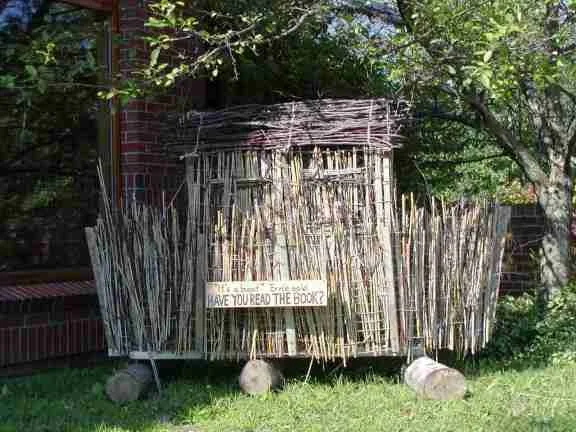
Ernie’s ark built as part of “One Book, One Community” celebration in Scarborough, Maine.
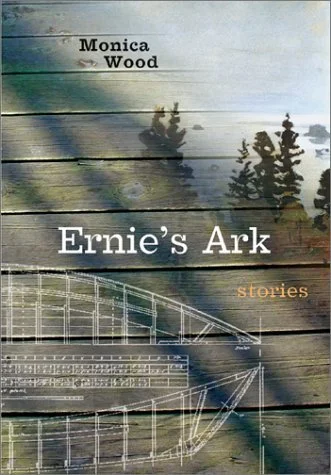
Original Edition
Ernie’s Ark
An Indie Next pick
Chosen for a “One Book, One Community” project by Oxford Hills, Maine; Winthrop, Maine; York, Maine; and Scarborough, Maine
“That One Autumn” from Ernie’s Ark was a “Selected Shorts” radio reading, recorded in New York City in May 2006.
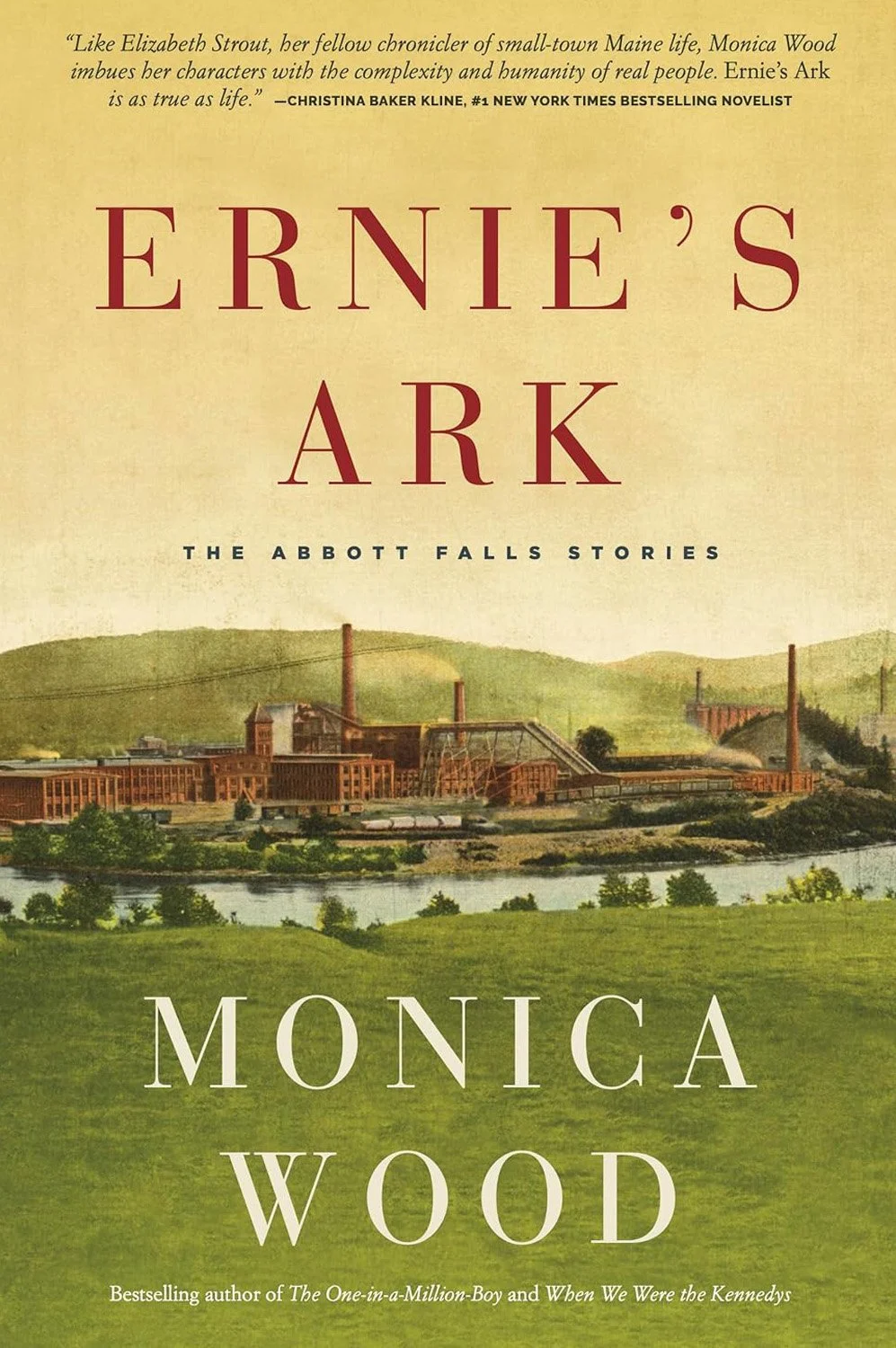
This is an anniversary edition of Ernie's Ark, which includes an additional story that didn't make it into the original, and a slightly new title: Ernie's Ark: The Abbott Falls Stories. I love the cover – a colorized photo of the paper mill in my hometown of Mexico, Maine. With many thanks to Josh Bodwell and the good folks at Godine.
Ernie’s Ark is a book of connected stories set in the fictional paper-mill town of Abbott Falls, Maine. When the paper mill goes out on strike, Ernie Whitten, a pipefitter taking care of his dying wife, builds an ark in his backyard, an act of faith and defiance that reverberates throughout the community in unexpected ways. The characters that populate Ernie's Ark – among them a razor-tongued CEO, a schoolgirl in love with Jesse Jackson, a pair of brothers testing their family ties, and a former delinquent desperate to amend an old crime – fulfill one of the author's recurring themes: the inevitable and often misdirected human desire for connection.
REVIEWS
“Intelligent and warmhearted stories...quietly wonderful fiction...for any reader drawn to mature examinations of what binds and divides people in all kinds of relationships. [Wood’s] voice is her own, assured and beautiful...She does a splendid job of building a whole out of these parts. Each story can easily stand alone, yet every new one contains an object or memory we've seen in a previous story, usually from another perspective. The overall effect is one of panorama, the sense that though we haven't met everyone in Abbott Falls, we've cast a good long glance at the range of hopes and heartaches the town contains.”
Cleveland Plain Dealer
“Ernie's Ark [contains] the subtly disguised idea that anger, loss, and desperation are related and must be confronted...The loving character portraits that form her stories help us understand not only the people of Maine but also the human condition...Though Wood admires the people with whom she shares Maine, she neither patronizes nor reveres them. They regret, they love, they rally around each other, they hope. [Abbott Falls] is not such a bad place to live.”
Boston Globe
“Wood’s touching collection centers on Abbott Falls, a fictional Maine town economically dependent on a paper mill whose workers are on strike. Limning the intertwined lives of a small number of characters, the stories offer glimpses into the pivotal events of their lives...These quirky stories reaffirm faith in human resilience, even when adversity brings out the worst in human nature.”
Booklist
“Nine linked stories revolve around a beleaguered Maine paper-mill town in Ernie's Ark. Ernie Whitten is laid off three weeks before his retirement and constructs an ark in his backyard as a tribute to his dying wife, Marie. The CEO of the company that owns the mill takes a road trip with his estranged daughter and the results are both hilarious and harrowing. Monica Wood (My Only Story) does a remarkable job of illuminating the characters' inner lives-from disgruntled union workers to a flower store owner in a troubled marriage-skillfully layering their brief but complex stories with humor, empathy, and melancholy.”
Publishers Weekly
“Because another book about a dying factory town in Maine won the Pulitzer Prize this year, it would be easy to make Monica Wood’s “Ernie's Ark” suffer by comparison. Yet Wood’s slim, thoughtful short-story collection doesn’t let us. Whereas Richard Russo's panoramic Empire Falls is practically civic biography, the town of Abbott Falls, Maine, in Ernie’s Ark is a painful afterthought lodged in the souls of its characters [who] alternate between major and minor roles like players in a Robert Altman film. Wood handles each voice with such grace that she disappears inside it right away. . .Ernie’s Ark ultimately asks what our response to sorrow says about us. Looming like a silent smokestack is Abbott Falls itself, the tragedy each of the characters share. Held up to Wood’s previous two novels – longer, thorough examinations of a single relationship – Ernie’s Ark might seem a bit slight. And yet like an honest day's work, it is both simple and more than enough.”
San Francisco Chronicle
“Ernie's Ark contains all the depth and range of emotions that a full-length novel enjoys....Wood's stories, filled with hope and light, are a rarity and a welcome relief. Her strength is her ability to create clear and sympathetic voices for each of her many characters. By the time you finish reading, you will have a whole chorus of voices in your head, each echoing the rhythms of small-town life.”
Titan Magazine
“An eight-month strike has shivered apart Abbott Falls as neatly as though it were a chunk of mica; in her stories, Wood takes these fragments and holds them up to the light, revealing a world at once self-contained and wonderfully complex...It's a fine collection.”
Down East Magazine
“[Colorful, well-developed] characters alternate between major and minor roles from story to story, a technique that works to build a cohesive whole...The overall effect is panorama, the sense that although we haven't met everyone in Abbott Falls, we've seen the hopes and heartaches of the town’s residents. This work brings readers through all the depth and range of emotion that a full-length novel does, and by the time the last page is turned, the characters therein will be engraved upon the reader’s mind.”
Discover Maine: Maine’s History Magazine
“Wood’s gift as a writer is to invest her stories with real emotion...Take the title story, in which a laid-off pipefitter builds an ark in the back yard to please his dying wife...Wood uses deceptively simple language and an obvious sympathy for her characters to keep the tale triumphantly afloat.”
Casco Bay Weekly
“The stories have a collective movement...and it all comes together in a way that is both gripping and moving. By the end of the book, we know the characters very well and feel affection and sympathy for all of them...it is a testament to Wood’s skill as a writer that she is able to present so many points of view with such empathy.”
Wolf Moon Press: Journal of Art and Opinion
Questions for your Book Club
The ark is the central image of the book. What do you think the ark represents for Ernie, for his daughter, and for the town? How does its meaning change as the stories progress?
Each chapter focuses on a different character in Abbott Falls. How did the shifting perspectives affect your understanding of the community? Did any viewpoint surprise you?
How does the author portray a town under economic strain? Which story best captures the social and emotional impact of the mill strike?
Many characters in the book experience some form of loss—economic, emotional, or personal. Which portrayal of loss felt most realistic or most moving to you?
Which character did you connect with the most? Which character did you struggle to empathize with, and why?
How does Monica Wood use small acts (a gift, a gesture, a moment of connection) to reveal character and deepen the emotional themes of the book?
What does the book suggest about what it means to belong—to a town, to a family, or to a community? Which characters seem to feel “at home,” and which do not?
The book is composed of linked short stories. Did this structure enhance or distract from your reading experience? Would the themes have worked as well in a single, traditional novel?
How do the characters’ lives overlap in ways that build a portrait of the town? What connections between characters did you find the most unexpected or meaningful?
Discuss the role of forgiveness in the book. Are there characters who achieve forgiveness—of themselves or others? Are there characters who never reach that point?
The mill strike functions as both a plot event and a symbol. What larger themes does it highlight about work, dignity, and community?
In what ways does the small-town setting shape the characters’ choices? Could this story have taken place in a different kind of community?
How does Wood use humor or tenderness to balance the heavier themes of hardship and uncertainty?
Which story or chapter resonated with you the most, and why? Was there a particular moment you found memorable or emotionally powerful?
At the end of the book, what feelings are you left with about the future of Abbott Falls and the people who live there?
If you could add one more story to the collection, whose perspective would you want to see, and what part of the town’s situation would you explore?
What do you think the book ultimately says about resilience? Which characters show the greatest capacity to adapt or persevere?
How does the parent–child relationship (especially between Ernie and his daughter) deepen the larger themes of grief, responsibility, and hope?
What role does community support—or lack thereof—play in the stories? How do characters lift one another up, and how do they fail to?
Looking back at the whole book, what do you think is the central message or takeaway Monica Wood wants readers to reflect on?