
Book Club Discussion Questions Below
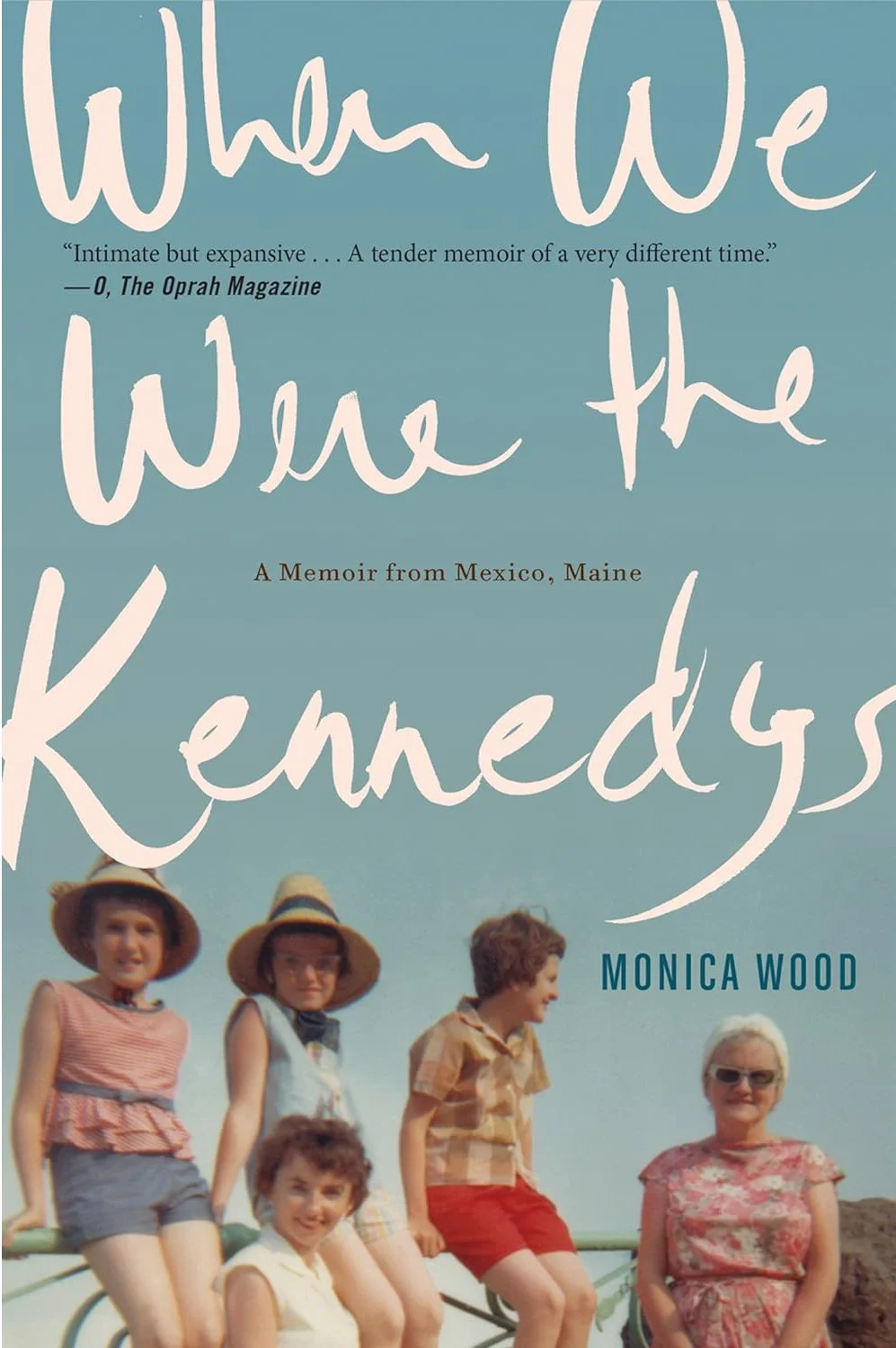
When We Were the Kennedys
Winner: 2012 May Sarton Memoir Award for best memoir by US or Canadian woman
Winner: 2013 Maine Literary Award for memoir
Runner-up: New England Book Festival Award in Autobiography
New England bestseller
Maine #1 bestseller
Oprah Magazine summer-reading list
IndieNext pick
Radio Boston summer pick
REVIEWS:
“Wood’s book...goes much beyond the story of her family’s grief. The book is a meditation on time... It’s also a record of a vanished way of life... By bringing such a town to life, with all its complexities and imperfections, it’s to Monica Wood’s great credit that she goes a long way to answering these questions.”
The New Yorker online
“In her intimate but expansive memoir, Monica Wood explores not only her family’s grief but also the national end of innocence. Braiding her own story of mourning together with the heartbreak all around her, Wood has written a tender memoir of a very different time.”
Oprah Magazine
“On her own terms, wry and empathetic, Wood locates the melodies in the aftershock of sudden loss...That a memory piece as pacific and unassuming as When We Were the Kennedys should be allowed a seat in the hothouse society of tell-alls is a tribute to the welcoming sensibility of its author and the knowing faith of her publisher. “
The Boston Globe
“It’s a pleasure to linger with her elegant prose, keen eye, and grace of thought.”
Reader’s Digest “Best of America” issue
“Wood’s gorgeously wrought new book...is a sharp, stunning portrait of a family’s grief and healing, and it also offer a refreshing lens through which to view the JFK tragedy, as his family’s loss helps the Woods feel less adrift in their own sea of anguish.”
The Washingtonian “Best of Washington” issue
“Readers of Monica Wood have long marveled at her powers of narrative conjuration, her ability to summon characters and landscapes and all-but-forgotten modes of living ...infusing them with raw vitality, and sending them off to their fates on the printed page. When We Were the Kennedys, a work of nonfiction, takes a very different approach: tipping present-day readers out of our armchairs and iPads and dropping us half a century into the past.....We’re living it all, fresh and new, through the mind and senses of nine-year-old Monica....And Wood lays it all out with piercing particularity....Most readers will feel a comparable surprise, I think, in discovering how easily they can lose themselves in a life story so unlike their own...”
Richard Grant in Down East Magazine
“...a marvel of storytelling, layered and rich. It is, by turns, a chronicle of the renowned paper mill that was both pride and poison to several generations of a town; a tribute to the ethnic stew of immigrant families that grew and prospered there; and an account of one family’s grief, love and resilience.” Maine Sunday Telegram
“Extraordinary, powerful and moving...This heart-wrenching, emotional, sometimes funny, oftentimes astonishing, and always compelling story is far better than the best novel...You will find yourself pausing, rereading entire paragraphs and thinking about what you’ve read...Read it and weep. Read it and wonder. Read it and rejoice.
Kennebec Journal/Waterville (Maine) Morning Sentinel
“This is an extraordinarily moving book, so carefully and artfully realized...Monica Wood displays all her superb novelistic skills in this breathtaking, evocative new memoir. Wow.”
Ken Burns, filmmaker
“A tender, plaintive...genuinely compelling depiction of family grief...a bittersweet, end-of-innocence family drama.”
Kirkus
“This year millions of words will be printed about the 50th anniversary of the assassination...None will be as moving as When We Were the Kennedys. ... Her brilliant, lyrical words pin us to Mexico...the time...those hopeful days before the ‘mighty, mighty Oxford’ went down under a cascade of labor disputes...before all the bright, ethereal promises of Camelot vanished.”
Yankee Magazine
“My great book of the summer...It’s a terrific book, telling the story of Wood’s family after the sudden death of her father when she was only nine. That’s sad, of course, but the book isn’t about being sad, it’s about being a family. It’s also about an era—the year was 1963—and draws a parallel between Wood’s story and the national loss of President Kennedy.”
Bill Roorbach in Orion Magazine
“A gorgeous, gripping memoir. I don’t know that I’ve ever pulled so hard for a family.”
Mike Paterniti, author of Driving Mr. Albert
“This is a beautifully composed snapshot of how a family, a town—and, later, a country—grieves and goes on.
“A shining example of everything a memoir should be.”
U.S. Catholic Magazine
“The finest memoirs need not only a compelling story, but reflection and insight that transform the material so that the reader is moved and changed. Wood [uses] a novelist’s skill to create thrilling moments of understanding.”
New Maine Times
“In this amiable, specific glimpse of small-town life in 1960s-era Maine...a refreshingly functional family learns to accept loss and preserve love.”
Publishers Weekly
“A lesson in family and communal ties, this book is a perfect summer read.”
Bangor Daily News
“This book is some of Wood’s best writing — lyrical, honest, and moving. It evokes a tangible time and place, and palpable emotions. When We Were the Kennedys is about a moment. The moment when everything started to change — for Monica Wood, and for so many others, too.”
Portland Phoenix
“Monica Wood is a stunning writer...If I were standing beside you, I would press this book into your hands.”
Lily King, author of The Pleasing Hour and Father of the Rain
“When We Were the Kennedys is a deeply moving gem!”
Andre Dubus III, author of House of Sand and Fog
“Wood’s new memoir, When We Were the Kennedys, feels immediate and intimate, even as it centers on events that happened before a good portion of her audience was born...Distinctly American.”
East Bay Express (Oakland/Berkeley)
“Wood’s writing is simply luminous as she conjures up a lost place and time....brought to vivid life by her prcise and poetic prose. Her skill at characterization is so refined that I felt I really knew each member of the family....Though it doesn’t shy away from the tragic and heartbreaking, Wood’s story is ultimately one of hope...the power of love and family...”
Story Circle Journal
Book Club Questions
The Author’s Note explains that the memoir is the truth as the author recalls it. How does this framing set the tone for the story? Would your reaction to the story change if you believed characters or timelines were fictionalized or rearranged?
Early in the memoir, Monica writes: “In my family, in every family, that story—with its implied happy ending—hinged on a single, beautiful, unbreakable, immutable fact: Dad.” How does this idea play out through the memoir? What other “immutable facts” define their town and families — and what happens when those facts shatter?
How does the presence of the local paper mill (the “mill” / company) shape the lives of the people in the town? In what ways does the mill define identity, community, and family fate for characters like Monica, her parents, and their neighbors?
After her father’s death, Monica remembers her mother’s body feeling “like a gently closed door.” What do you think she means by this? How does the memoir use physical and environmental metaphors to convey emotional pain and loss?
What does young Monica learn from stories her sister/Catholic teachers tell about explorers and world history? In what ways does she become an “explorer” of her own life and grief?
When Monica understands that the mill — and not the fathers — truly “owns” everyone’s livelihood, how does that realization affect the innocence and worldview of the Wood children? What does that say about power, class, and security?
The memoir describes the arrival of new families like the Norkuses. Why do some townspeople, including the Norkuses, feel like strangers in this tight-knit community? How do their reactions to loss compare with those of the Wood family?
Monica often compares her family to other families — real or fictional — in her search for understanding. Do you think she ever finds a perfect comparison? Why or why not?
Her mother draws comfort from identifying with a public figure after a national tragedy. What does it mean when her mother imagines a bond with the widow of a president? What does it say about grief, identity, and collective loss?
Religion and faith play a role in the memoir — for the family, the community, and the children’s upbringing. What role does Catholicism play in how the family copes with grief, loss, and identity?
Monica sees moments of “magic” in her everyday surroundings — in the paper-making process, in ordinary rituals, in simple transformations. What kinds of “magic” does she describe? What do those moments suggest about memory, hope, and resilience
There’s tension between the industrial/mill world and the innocence of childhood innocence. How does the memoir explore that tension? Does the mill world ever feel like a protective force or mostly destructive?
The final line of the book reads: “Thank you, I tell the dying beast. I forgive you.” What do you think Monica is thanking — and forgiving? How do you interpret that moment in the context of the memoir?
How does the concept of “home” evolve throughout the memoir — for Monica, her siblings, and her mother — before and after their father’s death?