
Tips for Writers
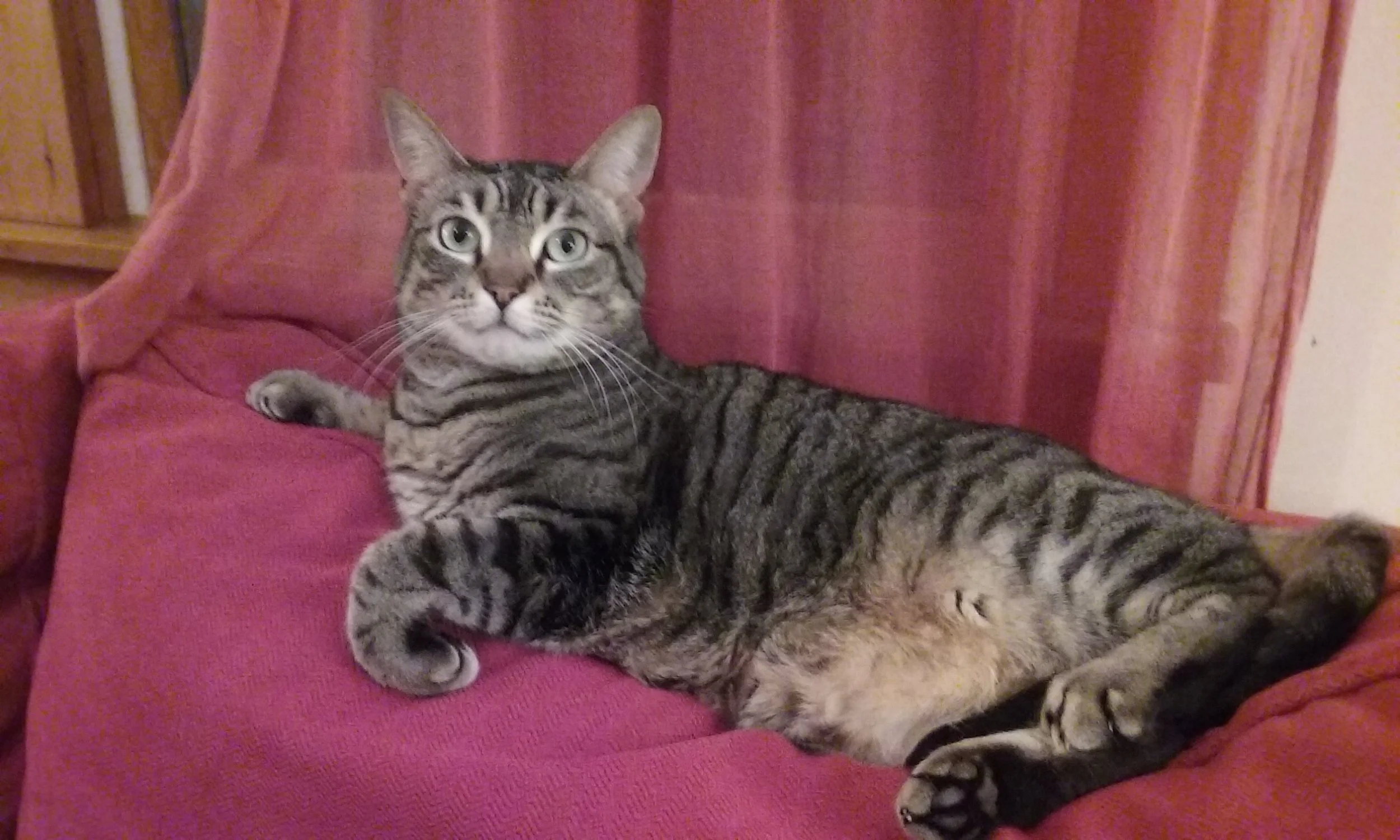
GET A CAT.
It worked for Mark Twain, Collette, and Henry James; it’ll work for you.
For some football-flavored advice, go here.
Stretch! Studies have shown that simply moving your head can “shake out” an idea. Isn’t that fascinating?
Persist, persist, persist. My novel The One-in-a-Million Boy is a big fat lesson in writerly persistence. I spent four years writing it, from 2004-2008, at which time I delivered it with great confidence only to have it rejected by my longtime publisher. Sparing you the details of devastation, I will say only that I put it aside for five years -- during which time I wrote a memoir and a play – then resurrected it, spent about eight more months on it, and sold it almost literally overnight. Ergo, I have a big sign in my workspace, just one comforting word: WAIT. And, while you are waiting, write something else.
Read your work aloud. I started writing plays late in the game, but the nature of playwrighting has only reinforced my longtime habit of reading my work aloud. An audience is unnecessary if you’re writing prose, but those oral (and aural) clues are still important, especially in the final drafts. You find all kinds of linguistical hiccups that hide in silence!
Color-code for structure. When revising, I color-code everything: speakers in scenes, time periods, even tenses in flashback scenes. I like any visual clues to the structure of a piece, and I often find clunky, overwritten passages this way, or stray bits that either don’t belong or should be expanded.
Hedge your bets. If you fear frittering away your precious writing time, try working on more than one thing at a time. I never used to do this, but lately I’ve embraced the practice. I can’t manage to keep more than two projects going at once, but I do like having options. It helps if option #1 is big (a novel or play) and option #2 is small (a 1000-word essay). When you come to an impasse on the first, the second awaits.
Think like an office manager. I keep things in colored folders, and lay them out like a work plan. It looks so organized that it makes me feel more confident. The green folder contains notes for a play; the red folder contains a draft of a story; the blue folder contains business stuff I have to get to. One might contain notes for a play.
Don’t show THEN tell: Go through your draft and look for every redundancy. Examples:
“You ass!” she shouted. Ditch “she shouted.” It’s already clear from the dialogue.
He loved the yeasty smell of baking bread. Your adjective here is too obvious, because we already know what baking bread smells like: yeasty. Pick a fresh modifier to make the sentence do two things, rather than one thing twice. E.g., “unsettling smell,” “clarifying smell,” or “hometown smell” gives us information about what the character might be feeling.
Read like a reader. Read your draft as if you were a reader and not a writer. In the late-ish stages of something, I print out a draft with all the character names temporarily changed to something I’d never choose. This helps me see the story afresh, allowing me to read the draft with one question in mind: Does the story hold up? Sometimes we get so hung up on making lovely sentences we forget our primary job, which is to tell a good story.
Write as badly as possible. A related exercise to “read like a reader” is to write out a blow-by-blow explanation of the plot in utterly pedestrian prose. You’ll quickly discover whether or not there’s enough story in your story. Put up a sign in your work area: STORY STORY STORY. The rest is frosting on the cake.
Do your daily work. Author Richard Russo was asked how he manages such long novels. He explained, so wisely, that a writer can’t do it all at once. “If it’s Monday, you just do your Monday work.” I found this advice indescribably helpful, because I’m one of those writers who try to do it all at once, and panic if I can’t. And of course I can’t! Nobody can! So, if today’s work is fixing one page, so be it. Do your Monday work. Save your Tuesday work for tomorrow.
Discover the magic of the egg timer. Time yourself. You’ll be amazed what you can accomplish in 25 minutes, or even five. I used an old-fashioned egg timer, the kind your grandma had in her kitchen. Keep the pen on the page, the fingers on the keyboard. DON’T STOP. At the end of your time, congratulate yourself and have a Reese’s peanut-butter cup. Or a cup of green tea, whatever rewards you.
Change your place. In a stuck place? Move. If you normally work at a desk at home, spend two hours in a library. A change of venue really, really helps. Especially libraries. I love them! Nobody talks to me, but I feel surrounded by the energy of human striving, which makes me feel less alone.
Turn off the damn phone. Nobody follow this advice, but I keep giving it anyway, because it is really, truly life-changing. During a writing session, turn off all vibrations/alerts/alarms/pings on your phone/computer/tablet/gadget-du-jour. Make a specific time to check texts, updates, emails, tweets, posts, all the many intrusive etceteras that are the enemy of concentration. Yes, we love them. Maybe we can’t live without them at this point. But be honest about what they are doing to your creative life. To repeat, in case a text came in as you read this: Our electronics are the enemy of concentration. If you are serious about writing, hit the “off” switch for your world, at least for a couple of hours. You will be amazed at the increase in your production.
Engage your inner life. Here’s a writing prompt that moved me, from poet Patrick Donnelly: Write a letter-poem (or just a letter) to someone to whom you may no longer speak. (They might be dead, or imaginary, or in jail, or otherwise gone from your life.) Use few abstract words (“love,” “pain,” “curiosity”) and many concrete words (“house,” “Church of England,” “penny,” “subway”), that is, words that allow the read to hear, feel, taste, touch, or see something.
Simplify. I learned the hard way that a 1000-word essay is about ONE THING AND ONE THING ONLY. Early drafts of this form usually introduce three or four concepts that the author tries in vain to connect in too few words. Simplify, simplify, simplify. That’s my advice. What you toss from those early drafts might become essay number two, three, and four.
Example: Let’s say your first draft is about the time your father bought a new truck with money your mother wanted to spend on a bedroom suite. (This is an example from a former student.) Your Dad was a hunter and the truck meant more to him than just a way to get around. Your mom, at the same time, put a lot of care and effort into the house, and the bedroom suite meant more to her than just furniture. Dad invites Mom for a ride in the truck, she refuses, but finally relents.
By the second draft you’ve tossed the bedroom suite and all its implications about sex and intimacy, but the diverted money is still there, searching for its place in the husband-truck-angry wife story. By third draft, you might also have cut the diverted and let Dad and truck rule the piece. Truck is Dad’s instrument of identity but also of seduction, as Mom finally gets in. Depending on your language, imagery, the piece can now work on literal level but also with all kinds of implication about the state of their marriage on the day Dad brings truck home.
The trouble with nonfiction is that it contains too many truths. (Dad and Mom never agreed about money. Mom liked money better than sex. Dad used hunting as a way to get away from Mom. Mom used house-decorating as a stay against loneliness. Dad loved Mom. Mom loved Dad. I didn’t know Dad loved Mom till I saw him hoist her into the new truck. I didn’t know Mom resented Dad until I saw her...etcetera forever.) Pick one. Write about that. (The student’s essay turned out pretty good!)
Emergency word list. One of my long-ago students came up with a great way to keep pen on paper. She used crossword-puzzle answers as random nudges, a version of an exercise I use in workshops called “word-a-minute,” in which I call out words which the students must insert instantly into what they’re writing. With no “caller” available, Lynn simply lined up words in advance and checked the list, in order, whenever her attention wandered or her confidence failed. Brilliant!
Make resolutions. I love resolutions. LOVE them. They tell me how I want to be (more helpful, more fair, more healthy, more fun), and it’s good to keep that picture of my ideal self in mind. So why not make a list of writing resolutions to remind you of your ideal writing self? Writing resolutions work best if they’re really specific, for example:
1. Finish section four by 3pm next Friday.
2. Work on the book from 6 - 7:30 on Monday, Wednesday, and Friday.
3. Read the draft of rejected book by March 1. Then decide whether to rewrite. If not, put it away for good.
4. Start new story/poem/essay/etc. every Monday morning for four weeks running.
5. Submit X for publication on the first of the month.
You might also trick yourself into keeping resolutions fresh in your mind by tying your task to a time:
1. Finish section four by four o’clock on the fourth.
2. Send out third story on February 3.
3. Finish Chapter 14 by June 14.
And so on. Good luck!
Dust and clean, metaphorically. After serving as a judge for a fiction competition, I have three tips for dusting and cleaning your manuscript before submitting:
1. Get rid of dialogue tags that are just sitting there doing nothing. Tags should be almost invisible, existing only to occasionally remind the reader of who is speaking, or to break up a line of dialogue in a rhythmically pleasing fashion. Stick to the simple stuff: he said, she said.
2. Please don’t begin your story with a character waking up, especially to the sound of an alarm clock. You wouldn’t believe how many writers do this. Really, you WOULD NOT believe it.
3. Think in terms of suspense, for every scene. In other words, we should know something at the end of each scene that we didn’t know at the beginning. Never, ever include in the final draft a scene you put in there merely as a bridge to the next scene. Skip it and jump to the next place in the story, preferably with a transition sentence that’s interesting in and of itself.
Dust and clean, literally. Few things feel more satisfying than a freshly washed floor. You’ve accomplished something. Use household tasks as fuel for getting unstuck.
Make a writing kit for emergencies. Here are the ingredients (doing this in a group is more effective and loads of fun):
1. A huge list of words you love, either for their sound, meter, meaning..
2. A list of 10 questions headed “How.” Example: How do they train monkeys to assist the handicapped? How does one interview for a toll-collector job?
3. A list of 10 questions headed “Why.” Example: Why did my aunt paint her house that color? Why did a woman like Lucinda marry a man like Mike? Why do Sundays always feel so sad?
4. A list of 10 “pairings.” With a friend, put together three columns: People; Places; Situations. In each column, write 10 items. (People: a priest, a hockey player, a hotel clerk, a little boy, a Russian doctor. Places: a park bench, the United Nations building, a backseat, the produce aisle. Situations: a burning house, a stolen suitcase, a bounced check, a betrayed secret. Taking items randomly from these columns, put together a list of 10 pairings. Examples: A priest meets a hotel clerk at a hockey game; a Russian doctor’s house is burning down; a little boy finds a stolen suitcase...
5. A list of 10 titles of unwritten stories you’d like to read or write. “The Broken Door.” “My Life in Sales.” “Fifty Ladies Dancing.”
This writing kit should help you jumpstart a laggardly writing session. Grab a word to fix a sentence, a pairing to begin a story, a “why” to deepen character, a “how” to embark on a research project, a title to get started.
Happy writing!
Embrace summertime distractions. I find summer a difficult time to write. If you’re like me, make the distraction of summer work for, not against, your writing practice. Examples:
Pack a notebook into your beach bag.
Add books on writing and/or writers to your summer list. I’m reading the letters of Steinbeck and a book called First You Write a Sentence.
Take advantage of the long days by writing at night. Even an hour a day will get you somewhere.
Write about heat: both literal and metaphorical.
Summer television/streaming stinks. Turn it all off.
Set an end-of-summer deadline to finish one thing: a chapter, an essay, a whole book, a first draft. Make the season work as a unit of time in which something must happen.
The scrolling marquee on my laptop helps. Every 60 seconds it reads, in humungous letters: DEADLINE DEADLINE DEADLINE!!! WRITE FASTER!!! This kind of thing lights a fire under your pants, believe me.
Some random tips. Here are a couple of tips from The Pocket Muse Endless Inspiration: New Ideas for Writing
Write a scene that depends on the failure of a reasonable expectation, such as:
an anchorman who refuses to speak
a car door that lacks a handle
a radio that receives a single station
a museum guard who touches the paintings
a faucet that delivers something other than water
One-word story shakeup:
Change a “no” to a “yes” and watch what happens.
Make an end run around your procrastination. This advice is metaphysical: When you’re NOT writing, forgive yourself. Life is long. Really. You can fit a lot in, especially if you quit social media.
Another random prompt. Write about an act of cruelty that yields the opposite of the intended outcome.
Embrace the list. Make a list. Of anything. Places you visited; boyfriends you dumped; jobs you quit; letters you never wrote; colors you hate; animals you admire; things you should have named; regrets that laid you flat. See where this list leads you.
More random tips. A couple of prompts from The Pocket Muse Endless Inspiration: New Ideas for Writing :
Write about the one who got away – and regretted it.
What’s the most you ever paid for something you didn’t want? Why did you fork over the dough?
Write about the worst holiday gift you ever gave.
A random prompt. Ah, spring. The birds are coming back, just as we knew they would. Write about a day when something that always happens ... doesn’t happen.
Make like a squirrel. Why not write a few beginnings – first lines, to be precise. Pile up as many first lines as you can manage. Like a squirrel hiding acorns, you can dig up these lines on some cold, uninspiring day in winter.
To get you started:
1. Papa told us that as soon as he returned he would spill the whole story.
2. The first thing you notice is the odd smell.
3. I tell this with all due deference to the harridan who calls herself my mother.
4. In a wide green clearing the boys found a rifle and a dog.
What arthritis? When was the last time you wrote longhand? I recently found myself feverish with inspiration and about two hundred miles from my computer. Hmmmm, what to do, what to do. After dithering for about half an hour, ruing my bad luck – yes, friends, I could not think of a way to make thoughts without technological intervention – I resorted to putting literal pen to literal paper. An interesting experiment that I highly recommend to other captives of the keyboard. My hand hurt later, but it was worth it.
Make like a dog. Dogs are famously food-motivated, and so am I. Delayed gratification is a powerful writing tool. Promise yourself a glass of beer/bonbons/potato chips/red wine/whatever for every x number of pages.
Naaah, spring! Aaah, spring: birds and bees, cycle of life, sunshine and tulips. ‘Tis the season when our worst sentimental impulses take over, and the Muse stands in the corner rolling her eyes. As the trees go all atwitter with returning birds, write some cold, dark, wintry prose. Possible kick-starts: a man waiting under a darkened Wal-Mart sign; four girls in a courtroom; a grim discovery (not a body) in a winter field.
And the last shall be first. Here’s a revision technique that requires guts and fortitude: Ask yourself what would happen to the story if the last line became the first line. Scary. And very effective. Often we have to write what seems like an entire story (or novel!) in order to get to the real first line. Don’t despair if you must discard all that came before. That’s just part of the process. The good news is that you’re starting with something you know about, rather than starting in the dark as you did with the draft you just tossed.
Do the writer’s version of the Swedish Death Cleaning. Time to clear out the workspace. You have to make the time for it, and bring reinforcements on the order of a great cup of coffee and a box of cherry chocolates. Schedule nothing else for the whole day or week. Exterminate the piles of paper! Re-shelve the unread books! Toss the leaky pens! File the heap of correspondence! Vacuum the rug, for God’s sake! Empty the trash, already! What, were you raised in a barn? This is metaphor in action, my friends! Make ROOM!
For the love of all that’s holy, get lie/lay straight. Resolve to use the past tense of “lay” correctly. In two otherwise wonderful novels I read recently, this mistake came up more than once. Why am seeing this over and over in so-called literary novels? Laid is the past tense of the verb to lay, which means to put or place something or someone. “Lay (put) your coat on the back of the chair, exactly where you laid (put) your coat yesterday.” Lay is the past tense of the verb to lie, meaning to recline. “Lie (recline) on this couch, the same couch where yesterday you lay (or lay down) yesterday.” Remember it this way: When good writers LIE down, they aren’t napping, they’re making up LIES for their next story. Please. This is not rocket science.
Split the diff. I’m struggling with two short stories at the moment: one has too little going on, the other too much. What if I take something from one story-in-progress and put it into another story-in-progress? I often catch myself writing two things that really should be one thing.
Beauty isn’t everything. Humans are attracted to beauty, no question. But if all your characters are beautiful, or even reasonably attractive, see what happens if you ugly someone up.
Try word association. When the words come hard, a word-association game with yourself can get you back on track. Start with an ordinary word: “tree.” Then start associating like crazy until you come up with something that interests you. Tree, bird, sky, plane, hijacking. Try it again, with “road.” Road, asphalt, steam, engine, battery, assault. You’ve just talked yourself back into writing.
A random usage tip. To be perfectly precise, use “persuade” when you mean getting someone to DO something, and “convince” when you mean getting someone to change their opinion. “I convinced Peter that our new landlord was evil, then persuaded him to murder the chump in his sleep.”
Welcome a new season. I’m writing this tip at the end of a hard winter. But really, every season has its hardships, and I like to ritualize each season as a new beginning. Celebrate a season change by acquiring something that will inspire your practice: a new pen, a handmade notebook, polka-dotted paper clips, 24-weight paper, a book of quotations...a gift that a writer would appreciate. Then give it to yourself.
Another cranky usage note. Why is everybody suddenly mangling the past tense of the verbs “sink” and “shrink”? ”The ship sank” is correct. ”His hopes sank” is correct. “Sunk” is used for the past perfect, as in: “The ship had sunk” or “his hopes had sunk.” Ditto the verb “shrink.” ”The dress shrank in the wash.” Movie titles notwithstanding, the proper form is “Honey, I shrank the kids.”
Are you a beginning, discouraged, or struggling writer? Here are some tips to help you with your writing – and your writing life.